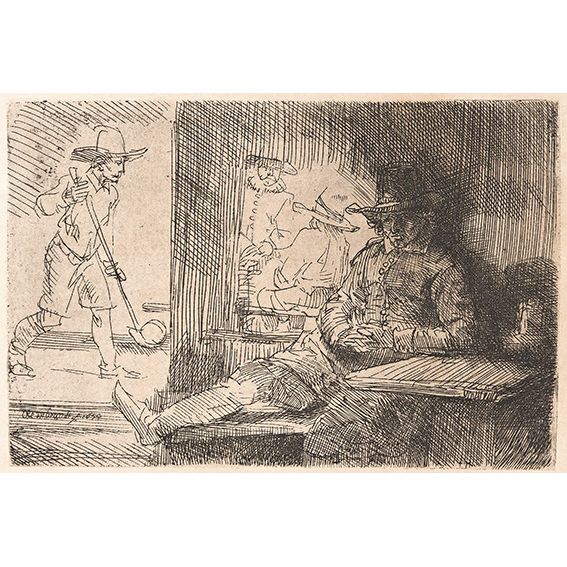
Rembrandt van Rijn, Original Etching, "The Golf Player" ('Het Klosbaantje')
Original Etching
Created in 1654
Size: 3.75" x 5.75" (9.5 x 14.4 cm.), small margins
Signed and dated "Rembrandt 1654" in lower left
Very clean, well-inked impression with sharp contrast.
Reference: Biörklund's second state (of 2); Usticke's second state (e) (of 3); Bartsch 125; Biörklund 54-A; Hollstein (White and Boon) 125; New Hollstein 282.
The subject of the print reflects a popular early modern game known as Ringball, closely related to what would later develop into Golf. Rembrandt structures the composition around two contrasting figures. One figure (on the left) leans forward, caught mid-motion as he prepares to strike the ball, his body angled and tense with anticipation. The energy of this pose suggests physical engagement, emphasizing action, balance, and the fleeting nature of movement.
In deliberate counterpoint, the second figure sits in the foreground (on the right), still and contemplative. His posture is relaxed, almost withdrawn, as if time has momentarily paused around him. Rembrandt renders this figure with darker dynamic lines, allowing stillness to dominate and encouraging the viewer to linger on his inward focus. The seated figure functions as a visual and psychological anchor, grounding the composition. Through varied line density and subtle burr, Rembrandt creates depth and space, demonstrating how etching could rival painting in expressive power.
Together, these two figures create a quiet but powerful contrast between action and reflection, motion and rest. Rembrandt uses this opposition to explore different states of being within a single, everyday scene. The etching thus becomes not merely a depiction of a game, but a meditation on time, attention, and the human capacity to shift between physical engagement and introspective pause.
Between these two opposing states, Rembrandt places two smaller figures in the background, whose presence mediates the visual and psychological dynamics of the scene.
Beyond its technical finesse, this etching reveals Rembrandt’s broader interest in everyday life and ordinary people. Unlike grand historical or biblical scenes, this artwork elevates a simple pastime to something contemplative and timeless. This is deeply embedded in Rembrandt’s view that continues to make his graphic works feel intimate, modern, and deeply human.
Explore the history of Rembrandt's etching plates throughout the centuries.